

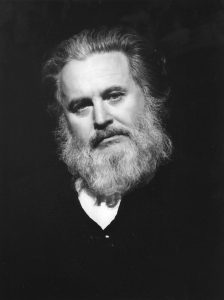
Miodrag Azanjac was born in 1932 in Kragujevac. He graduated in 1951 from the First Belgrade Gymnasium. He graduated from the High-School of Music and the Music Academy in Belgrade in 1958 in the class of Professor Jakov Srejović with excellent results in the main subject, as one of the most capable flute students. In the school year 1961/62, he used a scholarship from the French government, stayed in Paris and attended classes with the famous professor of the Paris Conservatory, Gaston Crunelle. During the summer of 1967, he stayed in Siena (Academia Chigiana) with the famous flutist Severino Gazzelloni. Even as a student, he was accepted into the orchestra of the Belgrade Philharmonic, where he quickly became the first flutist. He remained in the Philharmonic until 1970, when he transferred to the Music School “Mokranjac” in Belgrade as a permanent flute teacher.
Along with his work at the school “Mokranjac”, he also taught flute at the Music School “Dr Miloje Milojević” in Kragujevac, and in 1974 he became its director. In 1976, MidoragAzanjac was elected docent at the Faculty of Music in Belgrade. The entire artistic activity of Miodrag Azanjac took place in several directions. He acted as a concert soloist, as an excellent chamber musician (member of several chamber ensembles), orchestral musician, and in the last years as the artistic director of the “Flute Choir”, whose founder he was. His concert activity started from his student days. He performed as a soloist with numerous symphony and chamber orchestras, solo with harpsichord or piano, in Belgrade and other cities in Serbia and Yugoslavia. His performances in the music shows of Radio Belgrade were especially noticed. He performed with great success works of baroque, classics, as well as compositions by contemporary authors – foreign and domestic ones. He was the first flutist to perform a cycle of Bach’s and Handel’s sonatas in our country, which had a great effect on our music public, and was highly praised by music critics. He recorded a large number of compositions from the flute repertoire for the needs of Radio Belgrade, among which stand out works for solo flute, flute and harpsichord, as well as several concerts for flute and orchestra. The repertoire of Miodrag Azanjac was very rich and many authors of different epochs and styles were represented: Handel, Bach, Vivaldi, Couperin, Mozart, Hindemith, Jolivet, Debussy, Konjović, Joseph, Vauda and others. Miodrag Azanjac’s performance opus entitled “The Art of the Flute” was printed by PGP-RTB in a set of ten records. Among the numerous critiques, one could read the following: … “Miodrag Azanjac is certainly the most active music artist in Belgrade” (B. Dragutinović) … “As anlarge-minded artist, his art radiates and enriches our musical life” (A. Obradović) … “Miodrag Azanjac is a world-class artist” (S. Nikolajević). Miodrag Azanjac’s very fruitful and versatile activity was in the field of chamber music. For many years he was a member of the Belgrade Wind Quintet and one of the founders of this prestigious chamber ensemble of ours, with which he performed in many European and Yugoslav cities, performing works by domestic and foreign authors. The quintets of Ljubica Marić, Enriko Josif and Milan Ristić were recorded on records published by PGP-RTB. Miodrag Azanjac was a member and one of the founders of the chamber group “Musica Humana”, with which he performed at numerous concerts during four years of cooperation. The activity of Azanjac as an orchestral artist in almost all Belgrade orchestras is significant and unavoidable; the Belgrade Philharmonic, the Belgrade Opera Orchestra, the RTV Belgrade Symphony Orchestra, in which he played the first flute for years and toured throughout Europe. For his contribution to musical creation in Belgrade and Serbia, in the field of concert and chamber activities, Miodrag Azanjac received the following awards:
- October Award of the City of Belgrade – as a member of the Belgrade Wind Quintet, for artistic activity in 1970.
- Award of the Association of Music Artists of Serbia – for concert activity in 1971 and chamber activity in 1973.
- The first prize of the Yugoslav Radio Broadcasting – for the best recording in 1972 and chamber activity, that is, the recording in 1966.
- Award of the Association of Composers of Serbia in 1970.
Miodrag Azanjac founded the Flute Choir in 1977, composed of pupils and professors of music high-schools and students of the Faculty of Music. He was the artistic director and conductor of the ensemble, which performed at a large number of concerts in Belgrade, Serbia, at the Opatija Tribune, on television and at concerts organized by Radio Belgrade. A large number of compositions written for this ensemble were recorded for the needs of Radio Television Belgrade. The music public and critics have supported and followed the work of the Flute Choir since its founding and at a time when the ensemble gained full affirmation and became a significant musical figure in our environment. The essayistic work “Mythos and Logos”, a lecture on the topic named “Flute Time”, a lecture within the show of the Third Program of Radio Belgrade and participation in the Ninth International Congress of Aesthetics in Dubrovnik in 1980, should be emphasized within the artistic and research activity. As it has already been nicely written, behind Miodrag Azanjac there is “a very rich musical time (from Bach to the present day), with which this lonely poet inspired us until yesterday. Its flaring, burning, and combustion has opened our senses and is already an artistic task today.”His art “is built on the synthesis of mature musicality, technical perfection and a deep experience of music. That is why the flutist Azanjac is included, without a doubt, among the best Yugoslav and world-class artists. He is, as is well noticed, the Magic Flute of our days.” For decades, Professor Miodrag Azanjac wrote essays on the flute and musical creation, but he was also known as an excellent polemicist. In addition to essays and polemics, he published numerous conversations in many magazines, anthologies and newspapers. Part of his writing opus was collected in the book “Serbian Flute Art”.